Innovation portfolio.
This is a sample of my work, but more importantly, my process on not only how I approach patents, but innovation as a whole. There is other Dell IP I cannot share on this portfolio until it becomes public record. What follows is the process I run, four steps deep, with two of my granted patents shown as worked examples.
Patents worth filing start with a question stack.
What problem are we trying to solve? What is the value to the business? What is the technical and UX improvement to the end user? Has this been done before? Is it novel? If it is not novel in its entirety, are there inventive steps worth pursuing? Does this problem have scope? What are competitors doing? Is this even a problem worth solving right now?
Most of the questions get a sober answer. Most of the time the honest answer is no, this isn't worth pursuing. The discipline is in killing the idea early when the answers don't hold up, not in finding ways to make a weak idea sound novel.
More bad ideas than good ones. Filtering is the discipline.
I've had more bad ideas than good ones. Sticking to the process and keeping at it, I learned which ideas were best to leave on the sidelines and which were worth pursuing. The win rate gets better over time, but it never gets to one-in-one.
It starts with napkin sketches, whiteboard drawings, low-fidelity mock-ups, a conversation, you name it. The medium doesn't matter as much as the creativity and the pursuit of solving the problem. Keep uncovering. Keep asking what's underneath the obvious answer.
Not every idea is an immediate eureka. Sometimes you have to dig through the problem, get more questions, answer those questions, and keep going until you've hit a truly novel solution that holds up to scrutiny. The patents that survive committee review are usually the ones that survived three or four rounds of "but what about..." before anyone wrote a claim.
The deliverable is the product change.
This is where you and your team get to work. The patent shouldn't be first. The implementation into the workstream and the improvement into the product should come first. The patent can come later, once the idea has earned the right to be protected by surviving real engineering and real users.
High-fidelity mock-ups, prototypes shipped behind feature flags, working code reviewed by engineering. By the time a patent disclosure is written, the idea has usually been pressure-tested by people who didn't invent it, in conditions the original sketch never anticipated. That pressure-testing is what makes the disclosure defensible at committee.
Thirty-three filings in, the pattern is what matters.
After a decade and forty-five disclosures, I can predict with reasonable accuracy which ideas will make it through committee and which won't, before either of us writes the first claim. Novelty alone is not the predictor. Plenty of novel ideas die in committee for being too narrow, too vendor-specific, or too easy to design around. What predicts well is whether the idea sits at the intersection of something the customer noticed, something the engineering team had been struggling with, and something that could be expressed in claims general enough to matter ten years out.
The other thing I learned: the best ideas usually weren't mine alone. They came out of conversations where someone described a workflow that didn't make sense, and the team realized together that the friction was a symptom of an architectural assumption nobody had questioned. The inventor name on the patent is a legal artifact. The actual innovation was a group seeing the same thing at the same time and naming it.
Two patent committees taught me the rest. Enterprise Hardware and APEX Cloud. Sitting on the review side rather than the submission side changes how you write disclosures. You start writing for the reviewer's job, not for your own ego. That changes the hit rate substantially.
Four worked examples. Two public, two still under wraps.
The two patents below are granted and public on Google Patents. The figures shown are from the original IP-committee review decks, not the user-facing screenshots that ended up in product. Different artifacts, same idea at different stages of maturity.
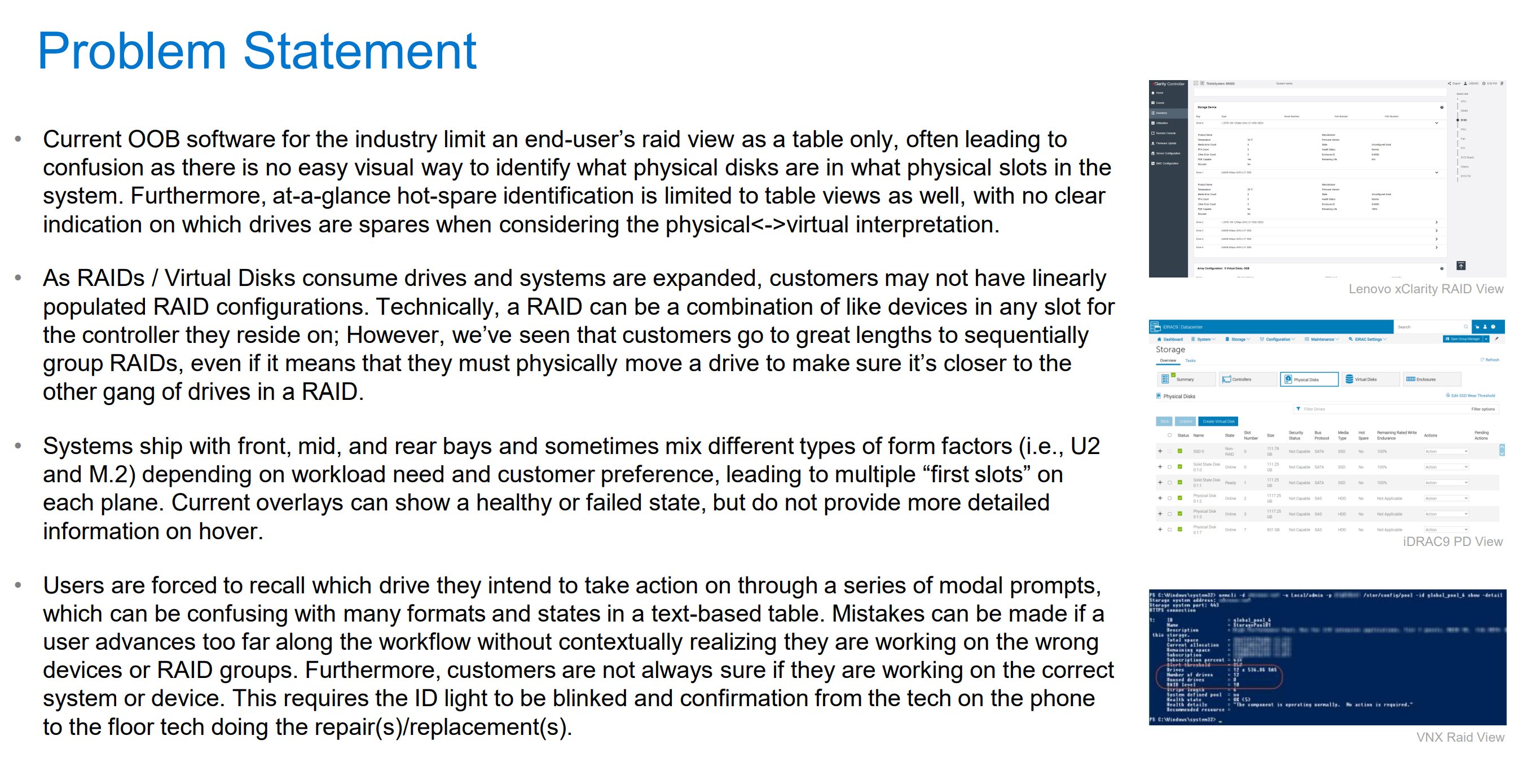
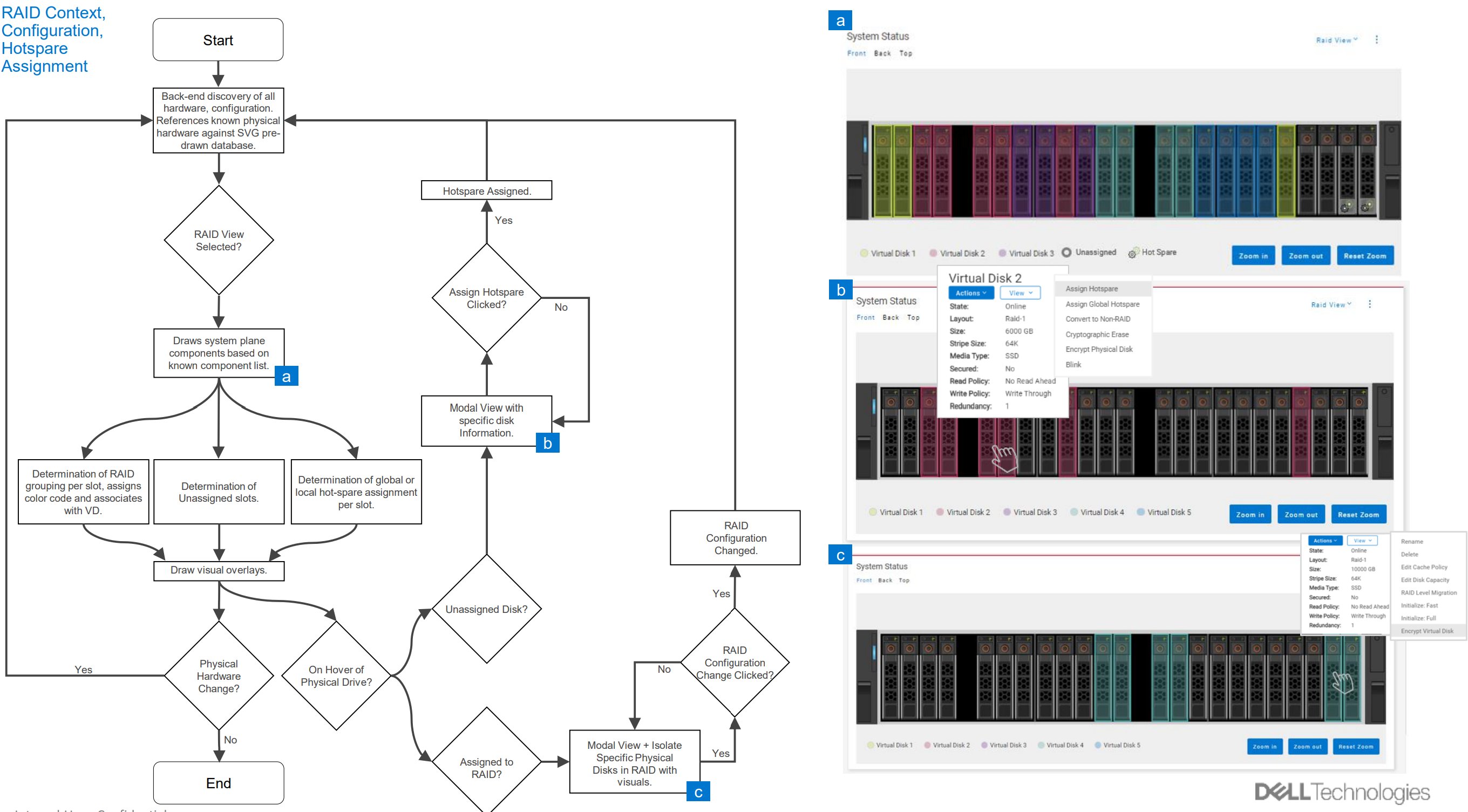
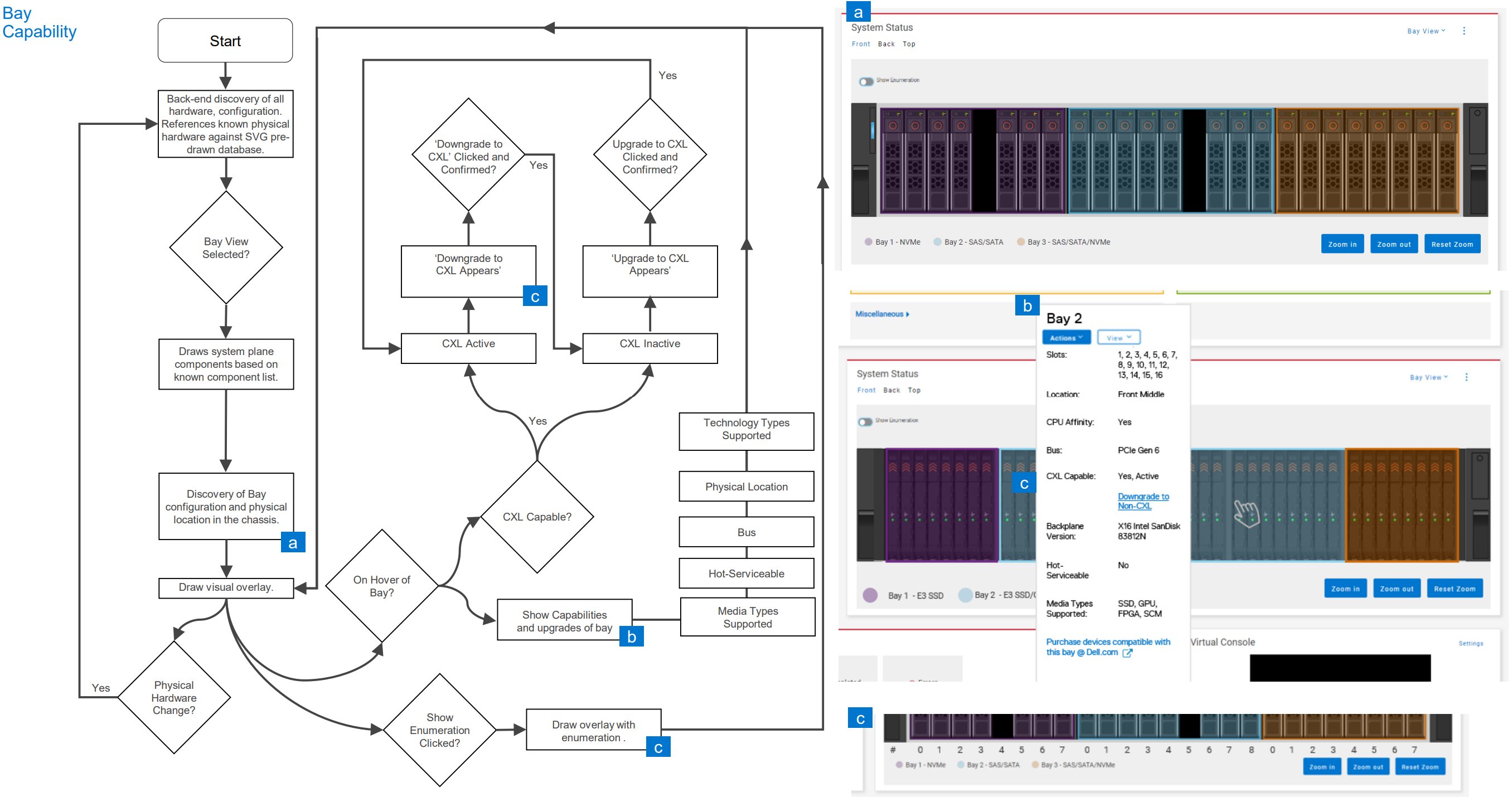
Replacing text-heavy RAID tables with glanceable, overlay-driven hardware context.
OOB software across the industry rendered RAID configuration as tables. Slot numbers, drive states, hotspare assignment, all in rows. The patent introduced a method using dynamically generated overlays of Physical Disk, RAID, Hotspare, and Bay state on top of an exact virtual replica of the system being interacted with. The end user can discern at a glance which physical disks are grouped together. The shipped feature in iDRAC is on the Context-Aware Enterprise UX case page. The artifacts below are from the original IP-committee review.
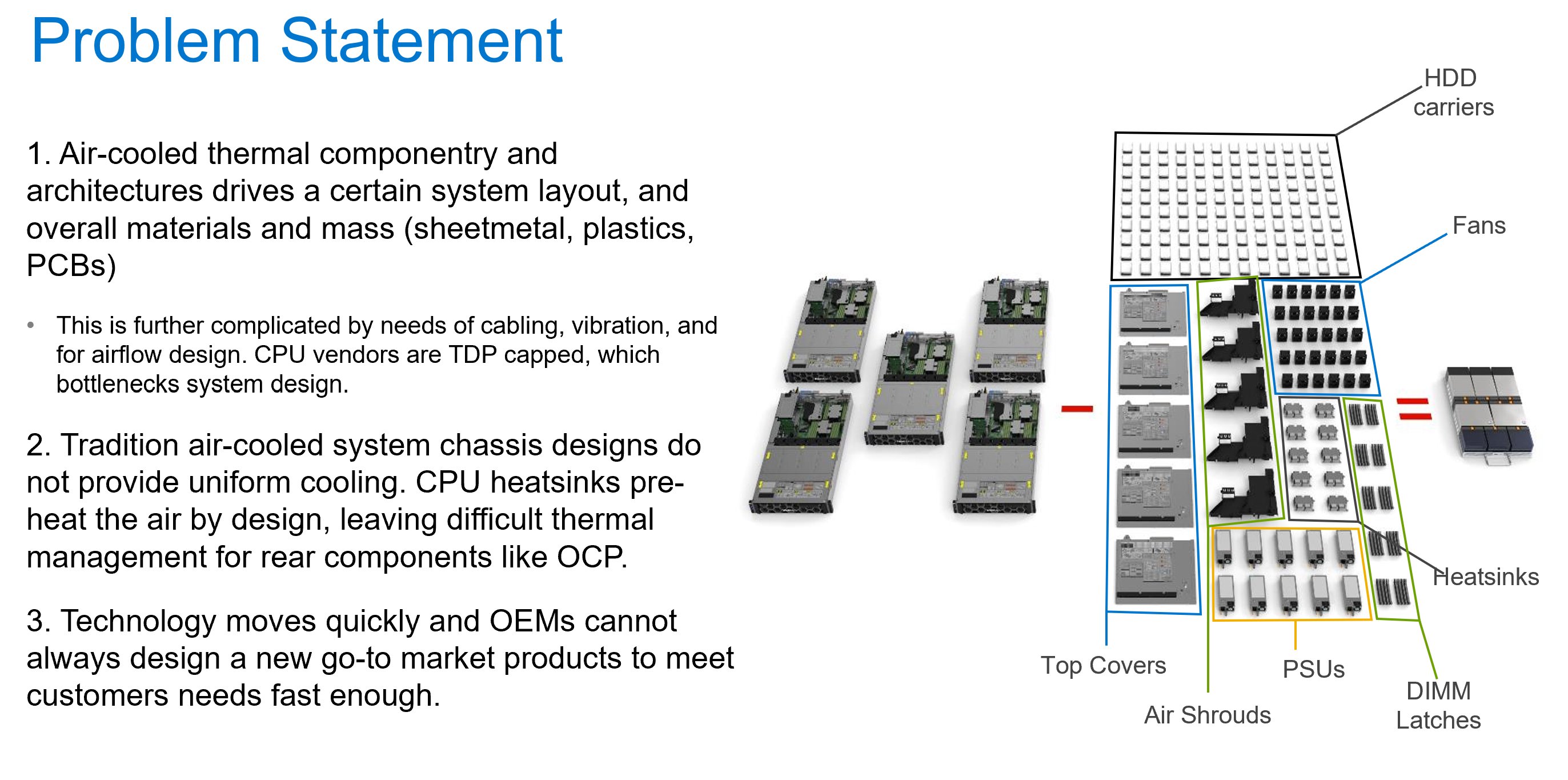
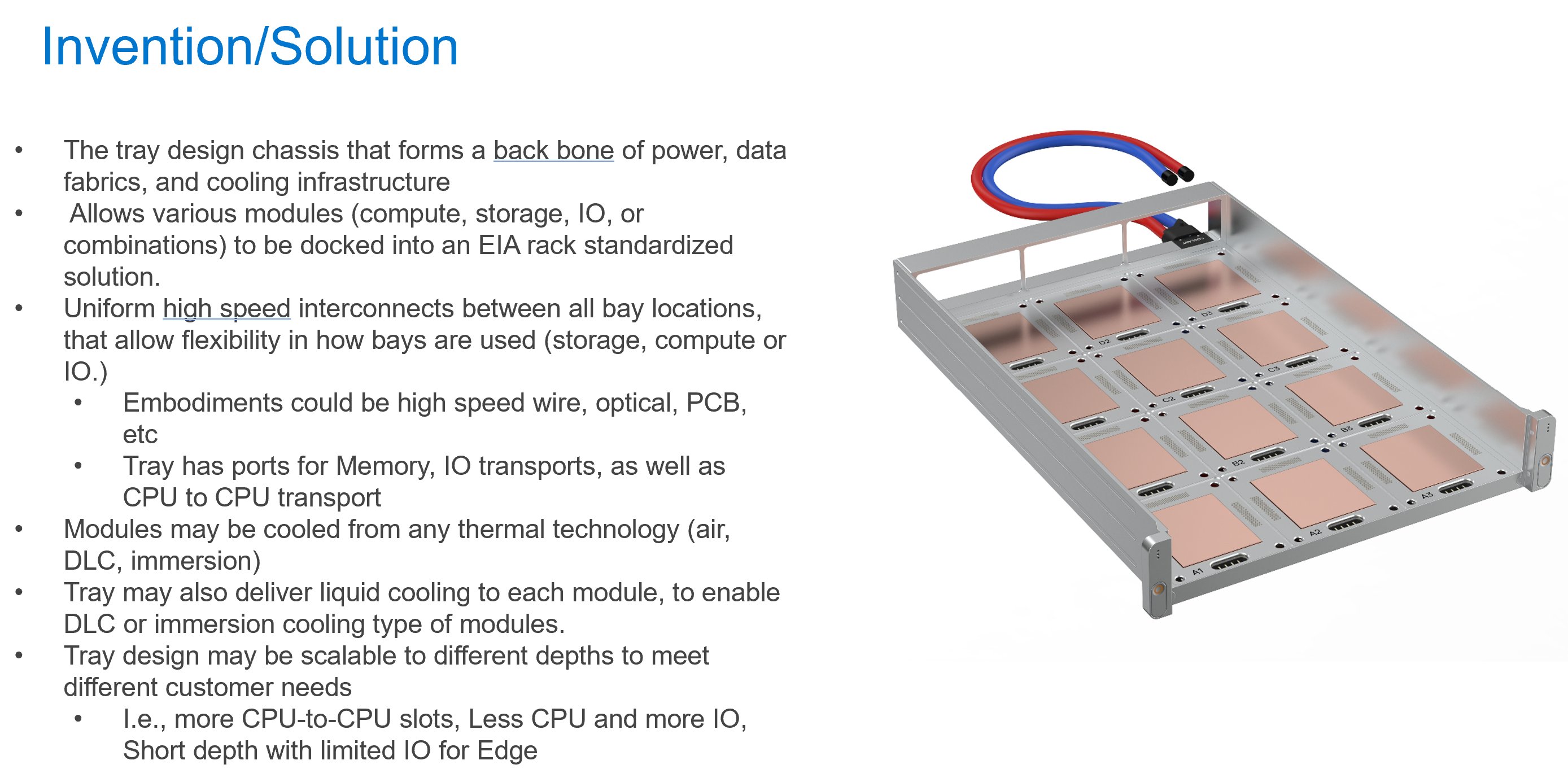
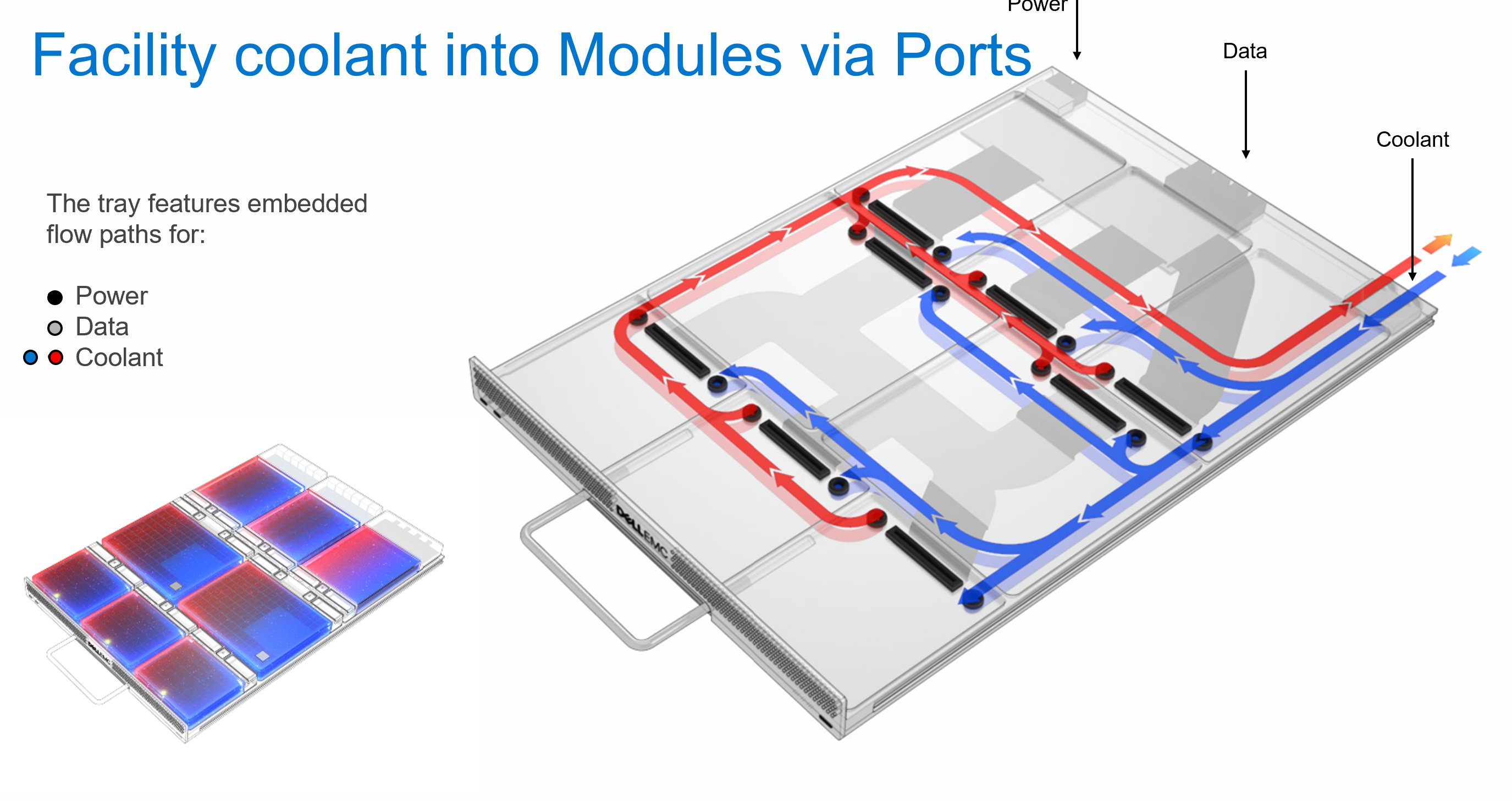
A tray-based chassis backbone decoupling compute, storage, and cooling.
Air-cooled thermal componentry drives a certain system layout, materials, and mass. Traditional chassis designs do not provide uniform cooling and CPU heatsinks pre-heat the air by design, leaving difficult thermal management for rear components like OCP. The patent introduced a tray design chassis forming a backbone of power, data fabrics, and cooling infrastructure, allowing various modules (compute, storage, IO) to dock into an EIA-rack-standardized solution. Modules can be cooled via air, DLC, or immersion. The same tray scales across edge, mid-tier, and full-depth deployments.
Worked example in progress.
Additional granted patents will be added here as their figures clear internal review. The artifacts shown are always the IP-committee review decks, not user-facing UI.
Worked example in progress.
Additional granted patents will be added here as their figures clear internal review.
There is other Dell IP I cannot share on this portfolio until it becomes public record.
The ten disclosures pending in the USPTO queue, and the disclosures submitted internally that haven't been publicly published, are not on this page. They will appear here as they clear public-record release. The process described above produced all of them.