Enterprise Horizons.
A cross-functional strategic foresight framework for Dell's Experience Innovation Group. Ten people (eight UX, two PdM) working for months to answer one question the org kept avoiding: where should design be looking three, five, and ten years out, and how do we pitch that to executives in a way that unlocks resources?
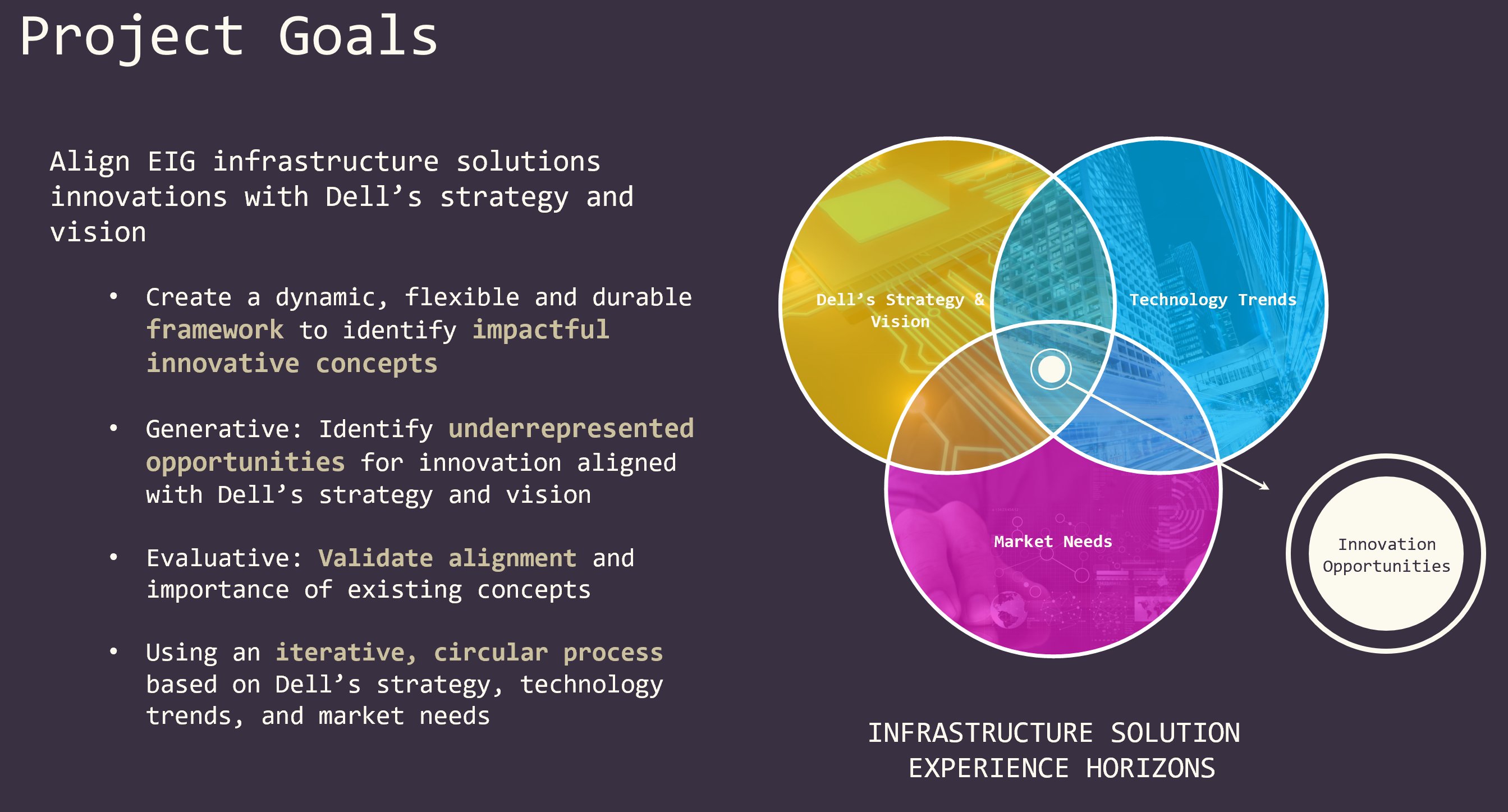
The UX team had no time for forward-looking work. Horizons made room for it.
By 2023, the EIG UX organization was a machine for delivering against committed product roadmaps. Solid work, respected team. What we weren't doing at scale was left-shift work, the speculative, upstream, pre-roadmap thinking about what we should be designing in three, five, and ten years. That case is obvious in the abstract and very hard to make concrete, a PdM leader looking at a committed roadmap will not hand you headcount for "thinking upstream." The ask has to land as something executives can price. Enterprise Horizons was the team we assembled to build that case. Ten people (8 UX, 2 PdM) with three leads, I was one of them, focused on content, analysis, and the executive story.
Forward-looking work starts with an honest read of the past.
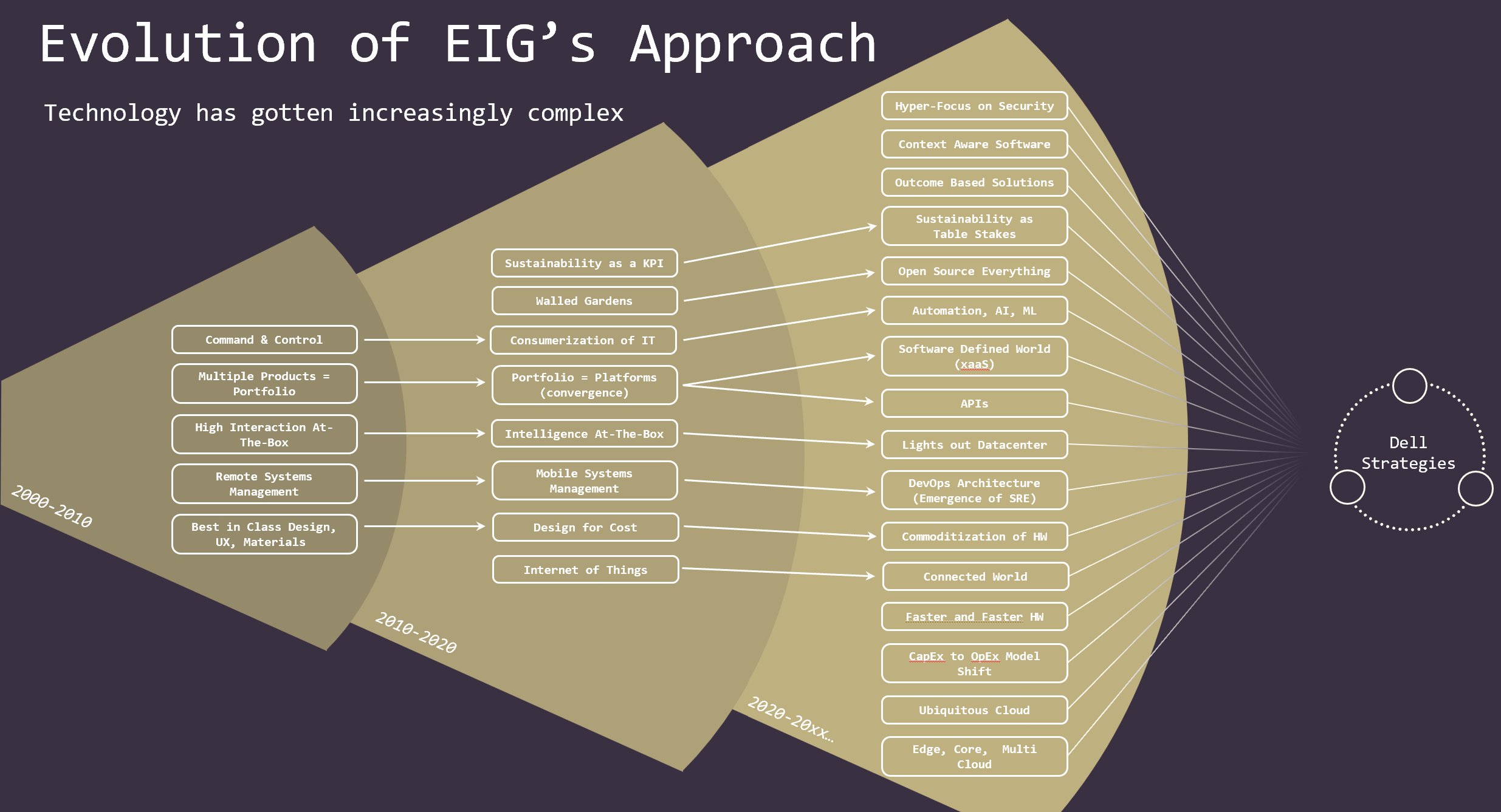
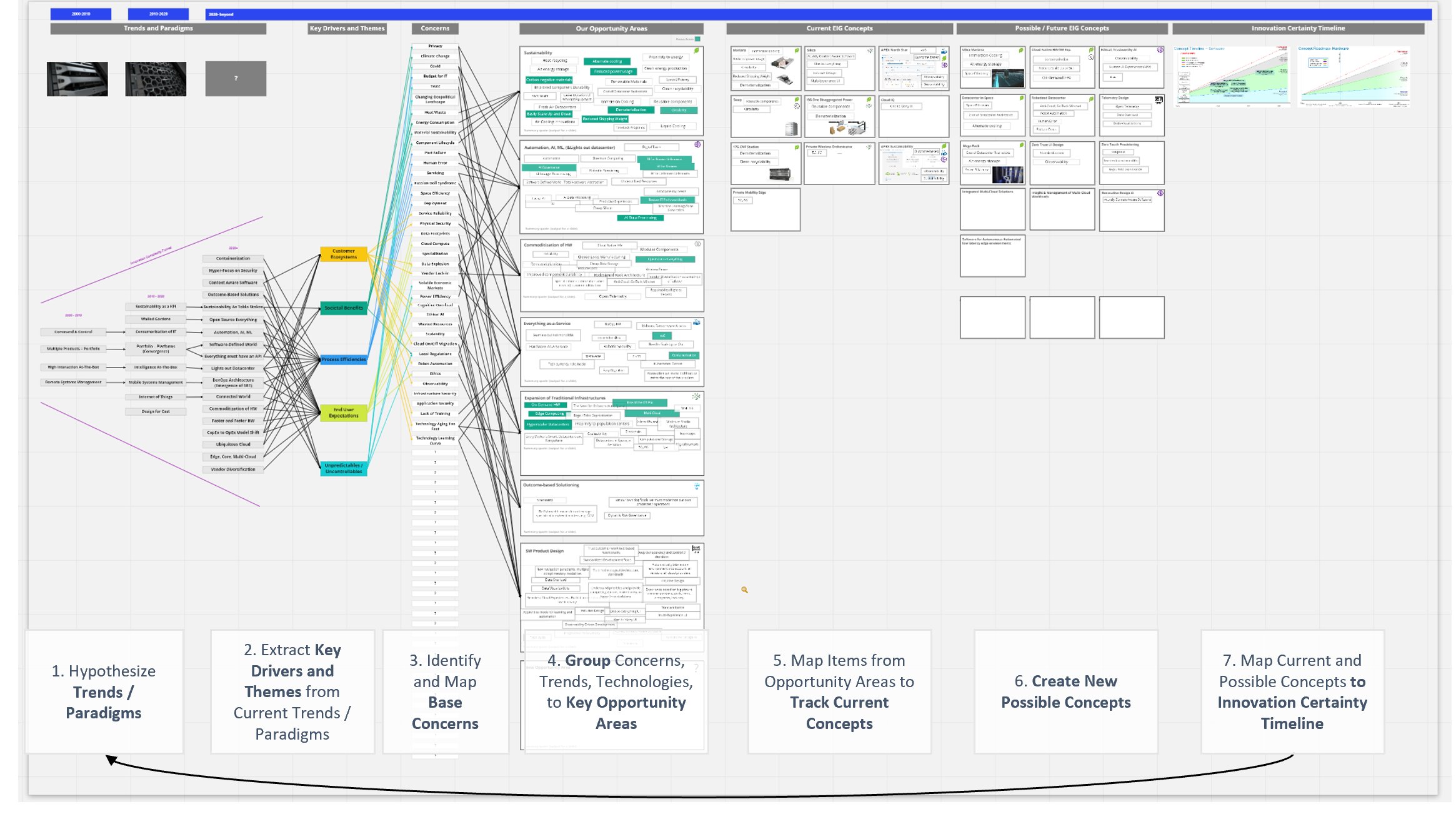
First move: ground the framework in EIG's own history. Two decades of it, honest. Early 2000s was "battling perceptions", command and control, hardware and software fighting each other, solutions assembled and troubleshot from the command line. The 2010s opened the scope dramatically, consumerization of IT, portfolios as platforms, intelligence at-the-box, sustainability as a KPI. 2020 onward is where the load blew up: security, context-aware software, outcome-based solutions, automation and AI everywhere, software-defined-everything, edge-core-multi-cloud. The lattice of things UX had to read and position against grew an order of magnitude. That's the first half of the executive story: design's scope has to shift left, because the complexity already did.
The framework had to align with Dell's strategy.
A trap we were careful to avoid: building a beautiful UX-internal framework that didn't map to anything a business leader actually owned. So we started with Dell's strategy and vision, then worked outward.
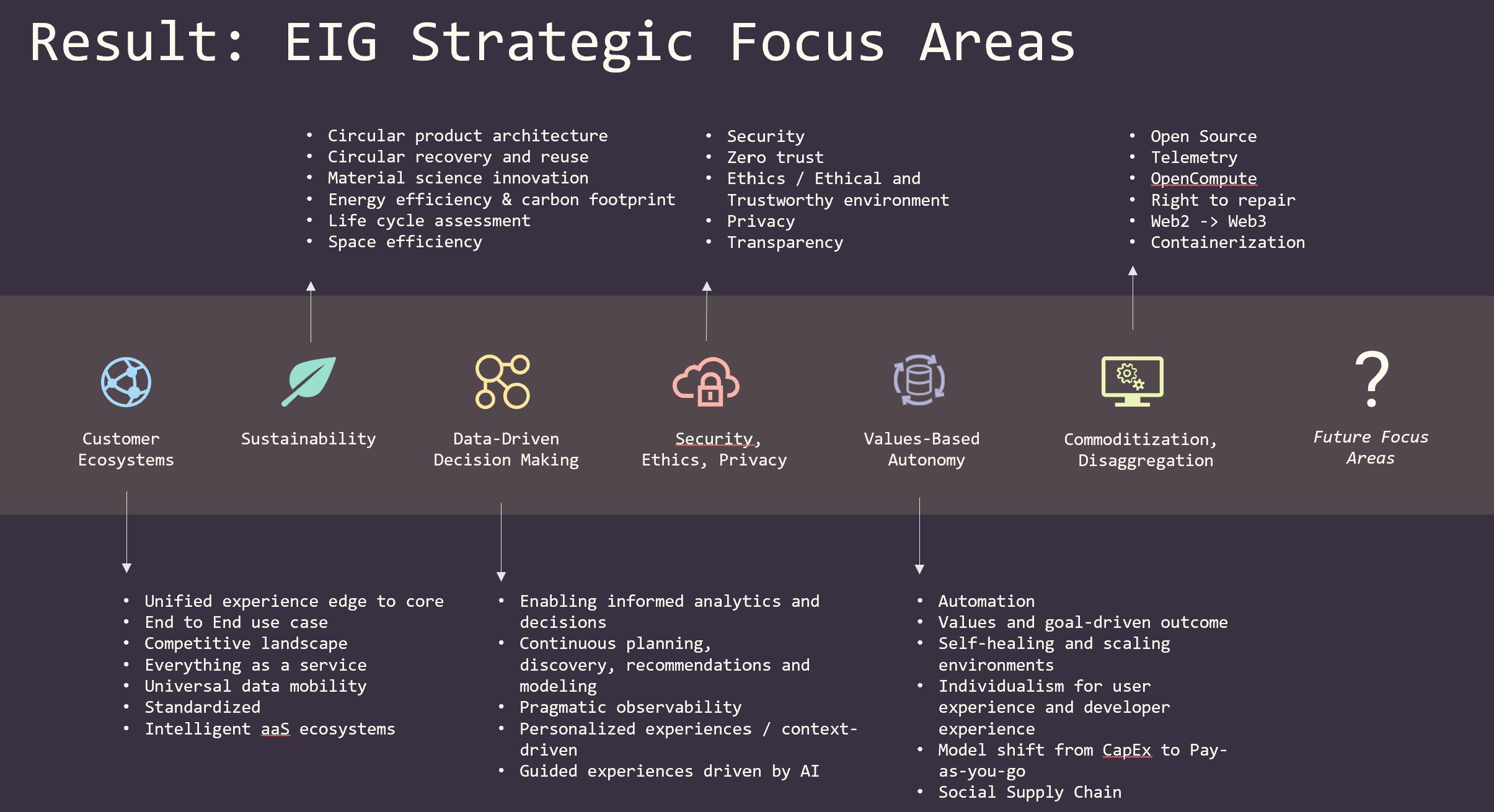
The result was six strategic focus areas synthesized from the strategy work, mapped against the concerns, technology trends, and customer signals we were collecting in parallel. Customer ecosystems. Sustainability. Data-driven decision making. Security, ethics, privacy. Values-based autonomy. Commoditization and disaggregation. Plus a seventh, deliberately left open: future focus areas, the placeholder for things we didn't yet have words for.
Each area got a concrete list of building blocks, not aspirations but specific items a PdM could point at and fund. Under sustainability: circular product architecture, recovery and reuse, material science innovation, energy efficiency and carbon footprint, life cycle assessment. Under security/ethics/privacy: zero trust, trustworthy environments, transparency. Under commoditization/disaggregation: open source, telemetry, OpenCompute, right to repair. The specifics were the point, they made the framework operable instead of rhetorical.
The strategic focus areas are not meant to replace the expected UX design principles (consistency, simplification, personalization, accessibility). Those are assumed. Horizons sits one layer above them, the conversation about what to design, before the conversation about how to design it.
A dashboard that reads left-to-right, like the argument it was making.
The executive-facing deliverable was a single long-form dashboard. Five movements in sequence so a leader can follow the logic in the order we arrived at it: Historic Trends (two decades of context), Dell Strategy (the strategic pillars the framework sits on), EIG Strategic Focus Areas (six plus a future slot, each clickable), Building Blocks for Innovation (the fundable specifics under each area), Concept Map (existing and proposed concepts plotted by depth of understanding and maturity), and Highlighted Concepts. The live version is interactive, built in Figma with clickable focus areas and concept drill-downs.
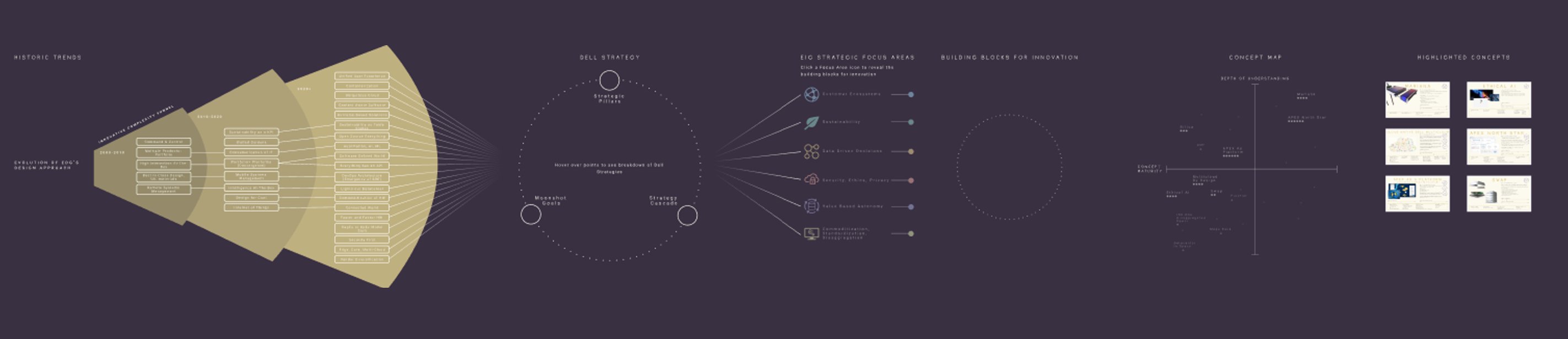
The dashboard reads left to right. The research underneath was iterative.
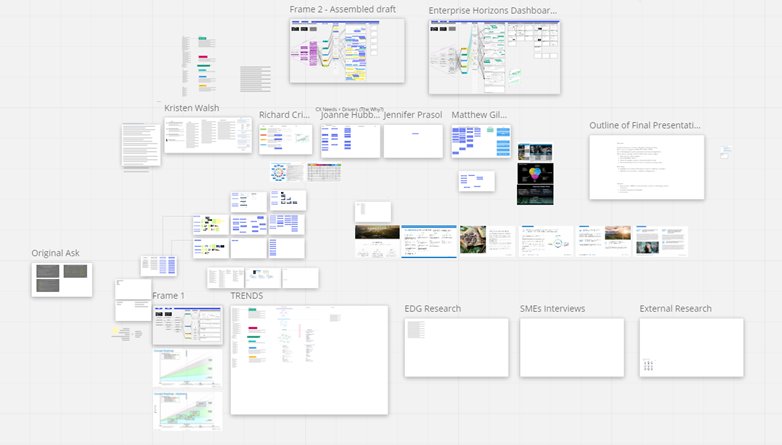
Two process shots, because how the sausage gets made matters for this kind of project. Ten people don't agree on the shape of three decades of infrastructure trends in a single workshop. They argue about it, in Miro, for weeks.
Funded. The team got to shift left.
Enterprise Horizons was built for one executive presentation in 2023. It worked. Leadership funded additional headcount specifically to give the UX team room to do left-shift work instead of being fully absorbed by quarterly delivery. A framework that justifies additional design capacity is worth more than one that wins a design award. This one had to translate into a business case an executive could act on, and did.